




Book Expert Service
Deciding Between 24-Hour Emergency AC Repair and Next-Day Service for a Seized Fan Motor
A seized condenser fan motor can quickly overheat your system in the brutal late-summer heat. Find out if you need immediate dispatch or if you can safely wait for morning service.

Is a Silent Outdoor Unit a Late-Night Cooling Emergency?
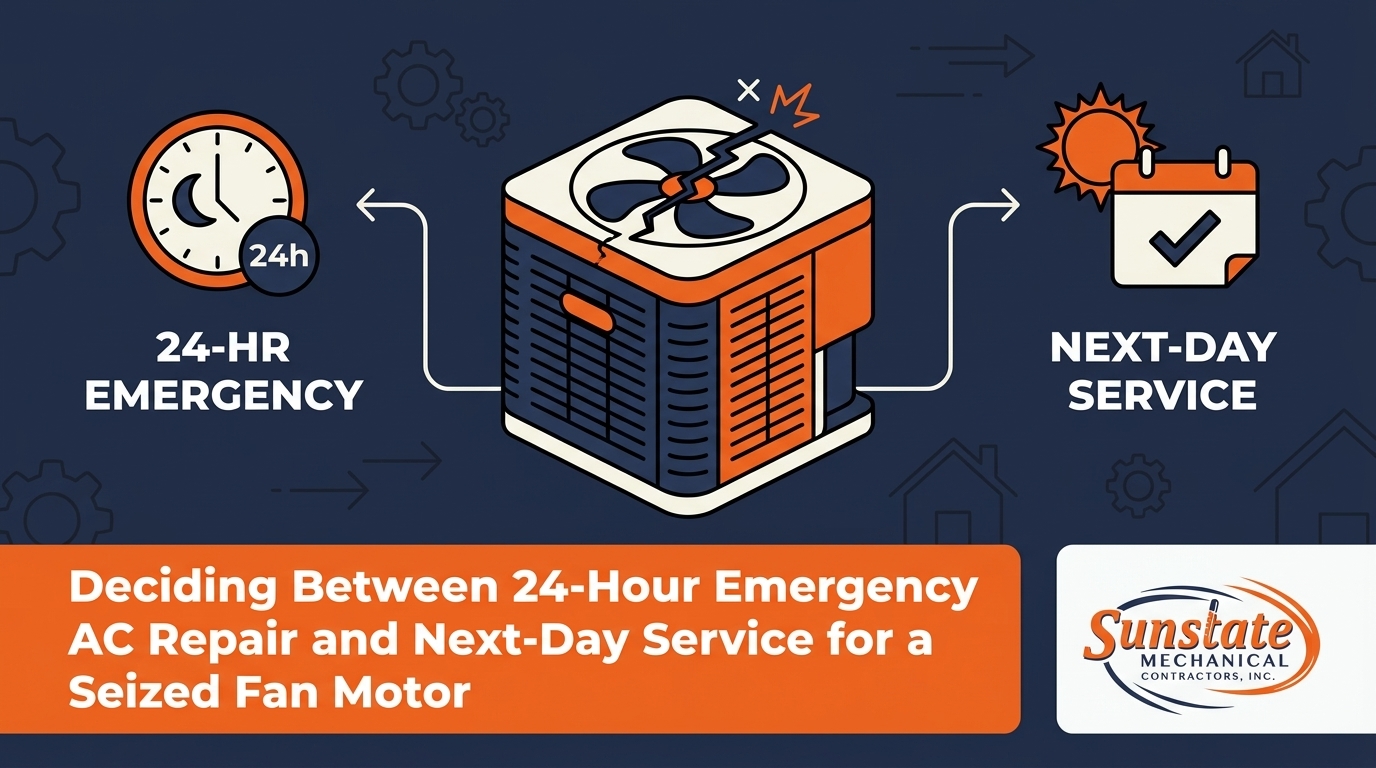
Are you standing outside in the dark, deciding between 24-hour emergency AC repair and next-day service for a seized fan motor? It is a stressful position for any homeowner to be in. You hear a loud humming noise, but the fan blades on your outdoor unit refuse to spin. Meanwhile, the indoor vents are blowing lukewarm air, and the house is quickly becoming uncomfortable. The immediate panic sets in as you wonder if the entire system is ruined and if you need to pay a premium for a midnight technician.
A seized condenser fan motor overheating from continuous operation is a serious mechanical issue, especially during the brutal August late-summer Florida heat. At Sunstate Mechanical Contractor Inc., our dispatch team fields calls about this exact scenario every week as cooling systems endure heavy end-of-season wear and tear. When the fan stops pulling air across the coils, your system loses its ability to release heat outdoors. However, making the right choice quickly can save your compressor from catastrophic failure and prevent unnecessary late-night dispatch fees. By understanding exactly what is happening inside your equipment, you can take control of the situation, protect your investment, and make an informed choice about when to schedule a repair.
For professional assistance, explore our Air Conditioning Services or schedule proactive AC Maintenance today.
The Immediate Triage Step: Shut Down the Thermostat
Before you even pick up the phone to request service, you must stop the damage from spreading. Running an air conditioner with a seized condenser fan motor prevents crucial heat dissipation. The outdoor fan's entire job is to pull outside air across the condenser coils, releasing the heat your system absorbed from inside the house. When that fan stops spinning, the heat stays trapped inside the equipment, creating a dangerous domino effect.
How Trapped Heat Destroys Your System
When heat cannot escape, the refrigerant pressures inside the system begin to spike rapidly. The compressor, which is the heart of your air conditioning system, is forced to work against these extreme pressures. In our years responding to late-night AC failures across Tampa, we've seen too many salvageable systems ruined simply because they were left running. Most modern AC compressors have internal thermal overload switches designed to trip and shut the system down if the fan fails. However, if you leave the thermostat set to "Cool," the system will continuously try to restart every time the switch cools down. This repeated tripping causes permanent electrical and mechanical damage.
Take these exact steps immediately:
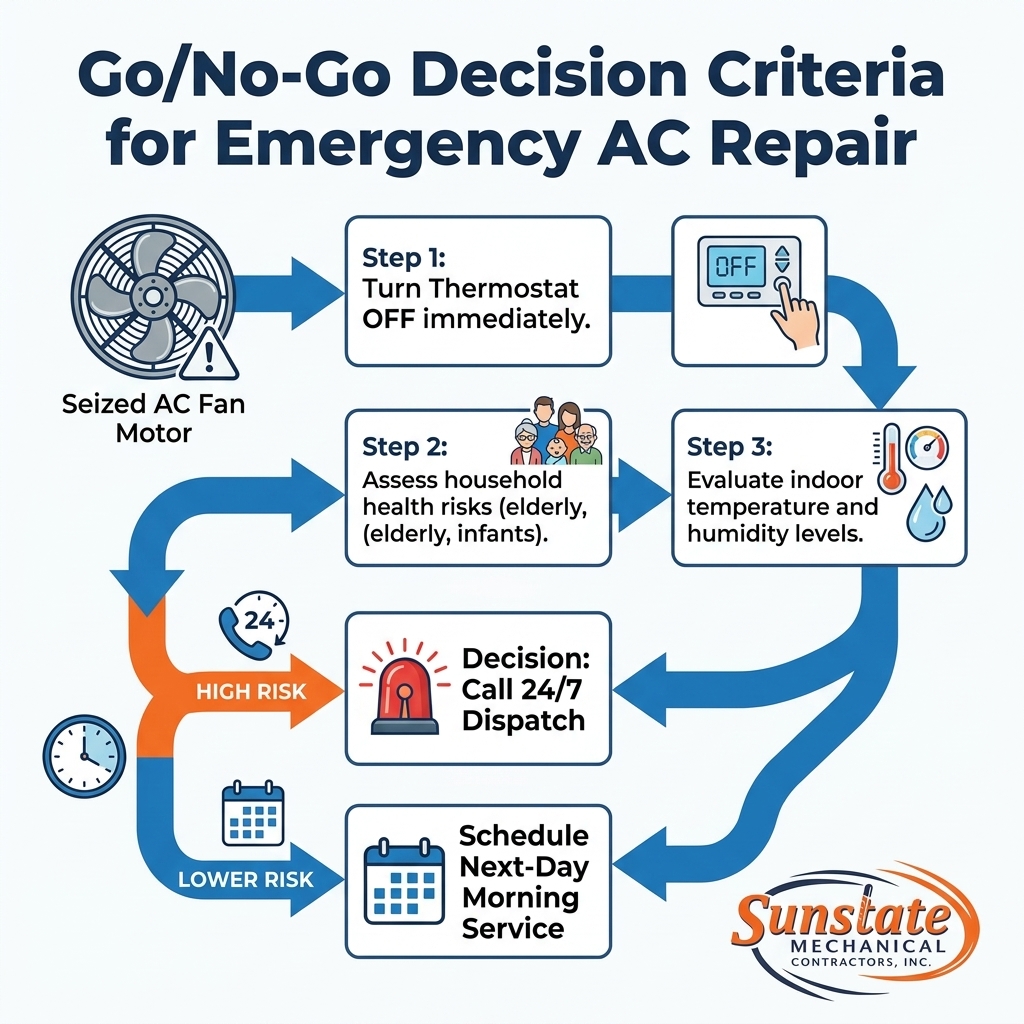
1. Walk to your thermostat: Do not try to diagnose the outdoor unit first. Go straight to your indoor control panel.
2. Switch the system to OFF: Change the setting from "Cool" or "Auto" to the "Off" position.
3. Turn the indoor fan to ON (Optional): If you want to keep air circulating through the ductwork, you can switch the fan setting from "Auto" to "On," but ensure the cooling cycle is completely disabled.
4. Do not open the outdoor unit: Never attempt to open the cabinet or manually spin the fan blades, as this exposes you to high-voltage electrical components and requires a licensed professional.
If a compressor dies because the system was left running, you might be looking at a full AC Installation in Tampa rather than a simple fan motor swap. (While generic federal tax credits or utility incentives may apply to qualifying energy-efficient replacements, avoiding a premature replacement entirely is always our goal for you.) When handling air conditioning and heating needs, getting customers up and running quickly is always our primary mission, but the system must survive the night first. Shutting it down immediately guarantees the damage is isolated to the fan motor itself.
Checklist to Decide on Emergency AC Repair vs. Next-Day Service
Once the system is safely turned off and the compressor is protected, you must evaluate whether your household can safely make it through the night. A broken air conditioner is always an equipment emergency, but our technicians typically advise that it only requires a 24-hour service dispatch if it creates a human health emergency.
Use this checklist to evaluate your situation:
• Assess household health risks: Prioritize emergency service if you have elderly individuals, infants, or immunocompromised family members in the home. These groups are highly vulnerable to rapid temperature changes and heat exhaustion.
• Evaluate the indoor temperature trajectory: Note how quickly the home is heating up without the system running. A well-insulated home might only gain a few degrees overnight, while an older, drafty home will heat up rapidly.
• Consider the forecast and humidity: Tampa's high coastal humidity index prevents sweat evaporation, making prolonged AC outages a potential health risk rather than just a comfort issue. If the overnight low remains oppressive, the lack of cooling becomes a safety hazard.
• Weigh the safety of shutting down: Consider whether you can comfortably utilize indoor fans and wait for daylight, or if the immediate need for a technician to restore airflow is non-negotiable.
Making the Go/No-Go Decision
Knowing When to Get Emergency AC Service in Tampa often comes down to balancing equipment protection with human safety. The table below outlines common scenarios to help you decide.
• Household Members — Emergency Dispatch Justified: Infants, elderly, or medically fragile individuals present. — Safe to Wait for Morning Service: Healthy adults and older children who can tolerate warmth.
• Indoor Temperature — Emergency Dispatch Justified: Already exceeding 82°F and climbing rapidly before midnight. — Safe to Wait for Morning Service: Holding steady around 76-78°F with good insulation.
• Outdoor Conditions — Emergency Dispatch Justified: Severe heat wave with extreme overnight humidity levels. — Safe to Wait for Morning Service: Mild evening breeze or a rare dip in overnight temperatures.
• Time of Breakdown — Emergency Dispatch Justified: Early evening (e.g., 6:00 PM) when the house is still baking. — Safe to Wait for Morning Service: Late night (e.g., 2:00 AM) when the sun is down and morning is near.
Managing the Heat: Surviving a Humid Night Without AC
If you decide that your household is healthy enough to wait for standard morning hours, your next challenge is staying comfortable while the equipment remains powered down. As local families transition into the back-to-school routine this August, we know how critical a good night's sleep is. We often remind our customers that generic advice like "just open a window" fails miserably in our coastal climate. Late-summer nights in the region maintain oppressive humidity, requiring active indoor air circulation rather than relying on stagnant, heavy outdoor breezes. Opening a window often invites thick moisture inside, making the house feel stickier and warmer than before.
Utilize ceiling fans and portable indoor fans: Because the main AC is turned off, you need to create a wind-chill effect manually. Fans do not lower the temperature of the room, but they do cool the people in it by moving air across the skin. Position box fans or oscillating fans to blow directly across your bed or seating area.
Keep blinds and curtains closed: Even after the sun goes down, keeping window coverings tightly shut helps trap whatever residual cool air remains in the home. It also provides an extra layer of insulation against the warm glass.
Relocate to the lowest floor: Heat naturally rises. If you live in a multi-story home, the upstairs bedrooms will become uncomfortably warm much faster than the ground floor. Consider setting up a temporary sleeping arrangement in a downstairs living room or basement if available.
Stay hydrated and use cool compresses: Drink plenty of ice water and keep a damp, cool cloth nearby to wipe down your neck and forehead. During extreme late-summer heat waves, our local HVAC teams work extra long days to address customer needs. If you can safely manage the indoor climate overnight, you can often secure a prompt morning appointment without enduring the stress of a midnight emergency call.
Why Transparent Guidance Matters During a Late-Night Breakdown
Calling an HVAC company at midnight is incredibly stressful. You want immediate answers, but more importantly, you want honesty. Some contractors use the panic of a late-night breakdown to push immediate, premium-priced dispatch fees, regardless of whether the situation actually warrants it. At Sunstate Mechanical Contractor Inc., we believe true professionalism lies in providing honest triage over the phone to prevent unnecessary panic.
Empowering the homeowner: A reputable technician will walk you through the steps to secure your equipment first. By instructing you to shut down the thermostat, they ensure the problem does not escalate from a burned-out fan motor to a destroyed compressor. Empowering a homeowner to safely shut down the equipment and wait for morning service is often the most cost-effective and practical solution.
Long-term equipment health: The focus should always remain on the long-term health of your air conditioning system and the safety of your family. If the situation poses a genuine health risk due to extreme indoor temperatures, responsive 24/7 dispatch is absolutely essential and available. However, if the house is safe, waiting until daylight allows our technicians to source parts more easily and perform the repair under better working conditions.
Building real trust: Sunstate Mechanical Contractor Inc. believes in transparent guidance by openly telling customers when they can safely wait for next-day service. This approach builds genuine trust over competitors who might push unnecessary midnight dispatch fees. When you know a local company is looking out for your best interests—and your wallet—you can rest easier, even in a warm house.
Frequently Asked Questions About Broken AC Fans and Emergency Service
Can I run my AC if the fan is not spinning?
Absolutely not. Running the system without the condenser fan causes immediate overheating. The fan is responsible for exhausting the heat absorbed from your home into the outside air. Without it, that heat remains trapped inside the condenser cabinet. Continuing to run the system risks severe damage to the compressor due to extreme refrigerant pressure spikes, turning a moderate repair into a catastrophic system failure.
How do I know if my AC fan motor is seized?
The outdoor unit will usually emit a loud humming or buzzing sound, but the fan blades will not turn. This noise is the electrical current trying to force the motor to spin, but the mechanical bearings are locked up. Additionally, the system may blow warm air indoors for a short period before the thermal overload switch detects the dangerous heat levels and shuts the compressor down entirely.
Is a broken AC fan an emergency?
It is an equipment emergency requiring the system to be turned off immediately. However, whether it requires a 24-hour service dispatch depends entirely on the household's health needs and the indoor temperature. If you have vulnerable family members and the house is heating up rapidly, it is a dispatch emergency. If everyone is healthy and you can tolerate the warmth with indoor fans, it is safe to leave the system off and wait for morning.
What happens if the AC fan motor stops working?
Heat transfer stops entirely, preventing the system from cooling the home. The indoor evaporator coil will continue to absorb heat, but the outdoor condenser coil cannot release it. The compressor then strains against abnormally high pressures until its internal safety switches engage or the component physically fails. This is why shutting the thermostat off is the most critical step you can take.
Will a tripped thermal overload switch reset itself?
Many internal thermal switches will automatically reset once the compressor cools down to a safe temperature. However, if the fan remains seized, the system will immediately overheat again as soon as it restarts. This constant cycle of overheating, tripping, cooling, and restarting is known as "short cycling" on the overload switch, and it will quickly lead to permanent compressor failure if not serviced by a professional.
Make the Right Call for Your Comfort and Safety
Dealing with a silent outdoor unit late at night is incredibly frustrating, but knowing exactly how to respond puts you back in control. Summarizing the situation: shutting down the system at the thermostat is the single most critical first step you can take to protect the expensive compressor from permanent heat damage. Once the equipment is secure, you can evaluate your home's temperature and your family's health to make a calm, informed choice.
The decision between immediate dispatch and morning service always depends on household safety in the heat. If you are ever in doubt, reaching out to our team for professional guidance over the phone can provide the clarity you need. Furthermore, scheduling routine AC Maintenance can often catch a failing motor—like worn bearings or a failing capacitor—before it seizes completely in the middle of a hot August night. Protect your system, prioritize your safety, and rely on transparent professional advice from Sunstate Mechanical Contractor Inc. to keep your home comfortable.
Other Blogs





Flexible Financing Options for Your Needs
Enjoy flexible financing options to make HVAC services and upgrades affordable, ensuring year-round comfort without the financial stress.
Customer Reviews
We recently moved to Florida and needed major repairs to our church. After researching several companies, I went with Sunstate and I’m so thankful I did. Joe came out and provided us with the information necessary to make an informed decision and provided a reasonable estimate. We had a new unit installed, duct work repaired, and new thermostat installed. If you’re reading this review and wondering who to trust for your AC needs, please call Sunstate.

Charlie M.
Great job replacing both the condensing unit and air-handler. Moved the air-handler from the attic to the garage and re-designed and installed new duct work to accommodate the move. Works great and no more worries about overflowing drain pan damaging the ceiling and wood floors. Not to mention making it easier to maintain the AH unit. The guys worked through the night to make sure the AC was back on before they left the job. Thanks for a job well done.
Bob L.
Sunstate mechanical is truly the best contractors I have experienced since I moved into my house 30 years ago. I have been dealing with Joe and his crew for over 11 years now. They are a trustworthy, respectful, experienced crew who works with you and gives you a fair value. They just completed a big job replacing my A/C, gas furnance and condenser. They did an excellent job, no short cuts, made sure everything was functional, and cleaned up the area nicely before they left.
Denise S.
Sunstate Mechanical are absolutely one of the best. I have had two new units installed from them, and the work they did was spectacular. The crew was prompt (even called ahead to confirm the appointment), incredibly professional, and they left the area around the air handler somehow cleaner than when they arrived. I have had no issues with my units over the years because Sunstate Mechanical took the time to do it right the first time.
Cory C.
Sunstate Mechanical Contractors is by far a rare gem in Tampa Bay area when it comes to delivery the best service! They are very responsive very affordable. I have referred them to numerous friends and family who have experienced the same level of service as I have in the past! They only have good things to say about Joe the owner and his team! They also offer a great maintenance plan to keep things running in top shape! Thank you Sunstate! Keep up the great work!
Katrina D.

